
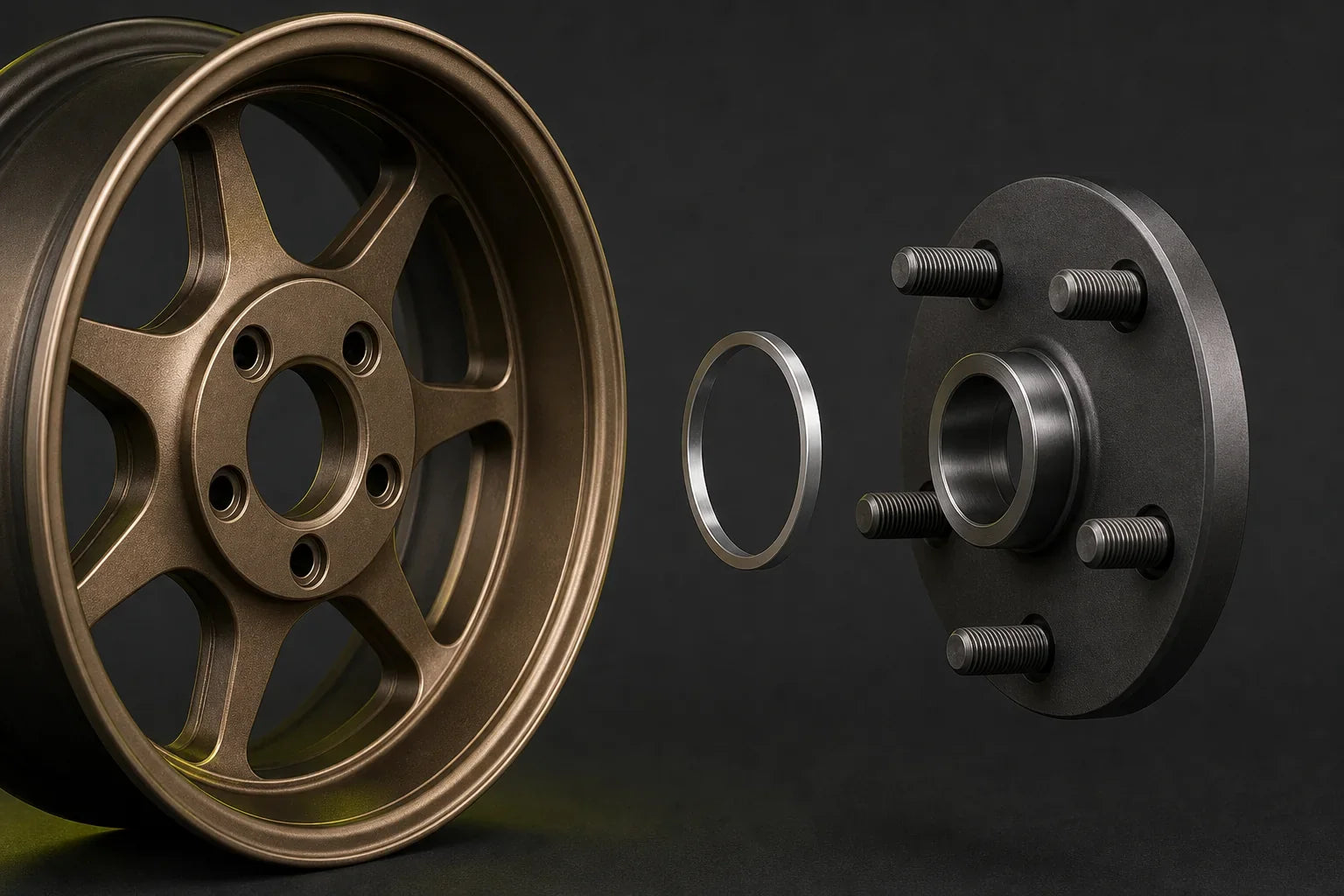

A hub-centric ring is a small component with a narrow job: it fills the difference between a wheel's larger center bore and the vehicle's smaller hub pilot so the wheel can be positioned concentrically during installation.
Center bore and hub pilot, defined
The center bore is the machined opening at the center of the wheel. The hub pilot is the raised cylindrical surface on the vehicle hub that enters that opening. On a direct-fit application, the two dimensions are closely matched within the intended tolerance.
Many aftermarket wheel families use a larger common bore so one wheel design can serve more than one vehicle application. A precisely sized centering ring reduces that bore to suit a particular hub pilot.
| Component | Its job | What it cannot correct |
|---|---|---|
| Wheel center bore | Provides clearance for, or a direct interface with, the hub pilot | An incorrect bolt pattern or unsuitable offset |
| Hub pilot | Provides the vehicle-side reference used to center the wheel | Wheel or tire imbalance |
| Hub-centric ring | Fills the dimensional difference between a larger wheel bore and smaller hub pilot | Brake clearance, load capacity, hardware or mounting-face errors |
| Wheel fasteners | Clamp the wheel mounting face against the hub using the specified seat and torque | A wheel that does not seat flat or uses the wrong fastener interface |
Does the center bore carry the vehicle's weight?
The installed joint relies on the wheel being correctly clamped to a clean, flat hub mounting face with the specified fasteners and torque procedure. The ring's principal role is centering during installation. It should not be treated as a substitute for correct clamping, suitable hardware or a compatible wheel.
This distinction matters because a ring is sometimes marketed as a cure for every vibration or fitment issue. It is not. If the bolt pattern, fastener seat, thread engagement or mounting surface is wrong, adding a ring does not resolve the underlying problem.
How to specify the correct ring size
A ring is described by two diameters:
- Outer diameter: matches the wheel's center bore.
- Inner diameter: matches the vehicle's hub pilot.
For example, a ring described as 73.1–66.6 mm is intended to interface between a nominal 73.1 mm wheel bore and a nominal 66.6 mm hub. This is only an example of the naming convention, not a recommendation for a particular car. Both dimensions must be verified for the exact application and actual component tolerances.
The ring should seat fully without distortion. It should not hold the wheel away from the hub face, contact a hub radius incorrectly or interfere with a dust cap. If the vehicle hub is larger than the wheel bore, a ring cannot help; the wheel does not clear the hub pilot.
Plastic or aluminum hub-centric rings?
Neither material is universally superior. The correct choice depends on dimensional accuracy, temperature exposure, corrosion environment and service requirements.
Engineering plastic or composite
A quality polymer ring can resist corrosion and may be easier to remove after road-salt exposure. It must still use a material suitable for the operating temperature and retain accurate dimensions.
Aluminum
A machined aluminum ring can provide a precise, durable interface. In corrosive environments, dissimilar materials and road contamination can make removal difficult if the mating surfaces are not maintained appropriately.
Material does not compensate for the wrong dimensions. A correctly specified, well-made ring is more important than a generic claim about metal versus plastic.
Installation checks that matter
- Clean the interfaces. Remove rust, scale and debris from the hub pilot and mounting face without damaging them.
- Dry-check the ring. Confirm it seats squarely on the hub or in the wheel bore as intended.
- Confirm a flush wheel seat. The wheel mounting face must contact the hub correctly; the ring must not create a gap.
- Use the specified hardware. Confirm thread, length, seat profile and any manufacturer requirements.
- Hand-start every fastener. The wheel should be supported and centered rather than hanging at an angle.
- Tighten in the specified sequence. Use the vehicle or hardware manufacturer's torque value and an appropriate calibrated tool.
- Recheck as required. Follow the installation and re-torque guidance provided for the vehicle and wheel system.
If any part binds, rocks or prevents full seating, stop. Do not pull the wheel into position with the fasteners.
What a centering ring cannot fix
- An incorrect pitch-circle diameter or fastener count
- The wrong fastener thread or seat profile
- Insufficient brake, suspension or body clearance
- An unsuitable wheel offset or width
- Insufficient wheel or tire load capacity
- A bent wheel, damaged hub or worn suspension component
- Wheel-and-tire imbalance or tire force variation
A ring also does not change effective offset. That is the function of wheel geometry and, where appropriately engineered, a spacer system. The two components are not interchangeable.
Diagnosing vibration after a wheel change
Vibration often gets blamed on a missing ring because the ring is easy to see. A useful diagnosis is more systematic:
- Confirm that the wheel and ring sit flush on clean, undamaged mating surfaces.
- Verify the wheel bore, hub diameter and ring dimensions.
- Confirm the correct fastener seat, thread engagement and tightening sequence.
- Inspect the wheel and tire for runout, damage and trapped debris.
- Check wheel balance and, where appropriate, tire road-force variation.
- Inspect the hub, bearings and suspension if the symptom remains.
The speed at which the vibration occurs, whether it is felt through the steering wheel or seat, and whether it changes under braking can help a qualified technician narrow the cause. Avoid diagnosing a safety-related installation by trial-and-error road testing.
Center bore and hub-centric ring FAQ
Can I install a wheel with a larger center bore?
It may be possible when every other fitment requirement is satisfied and the correct centering solution is approved for the application. A larger bore alone does not make the wheel compatible.
Can a machine shop enlarge a wheel's center bore?
Machining changes a safety-critical component and can affect material, geometry and certification. Do not modify a wheel unless the wheel manufacturer explicitly authorizes the procedure and a qualified specialist confirms the exact method.
Why is there still vibration with hub-centric rings installed?
The ring may be incorrect or not seated, but imbalance, tire variation, wheel runout, incorrect hardware, debris, hub damage or suspension issues are also possible. Inspect the installation as a system.
Are hub-centric rings the same as spacers?
No. A centering ring reduces the bore interface. A spacer changes the wheel's mounting position and effective offset and introduces separate hardware and engineering requirements.


