
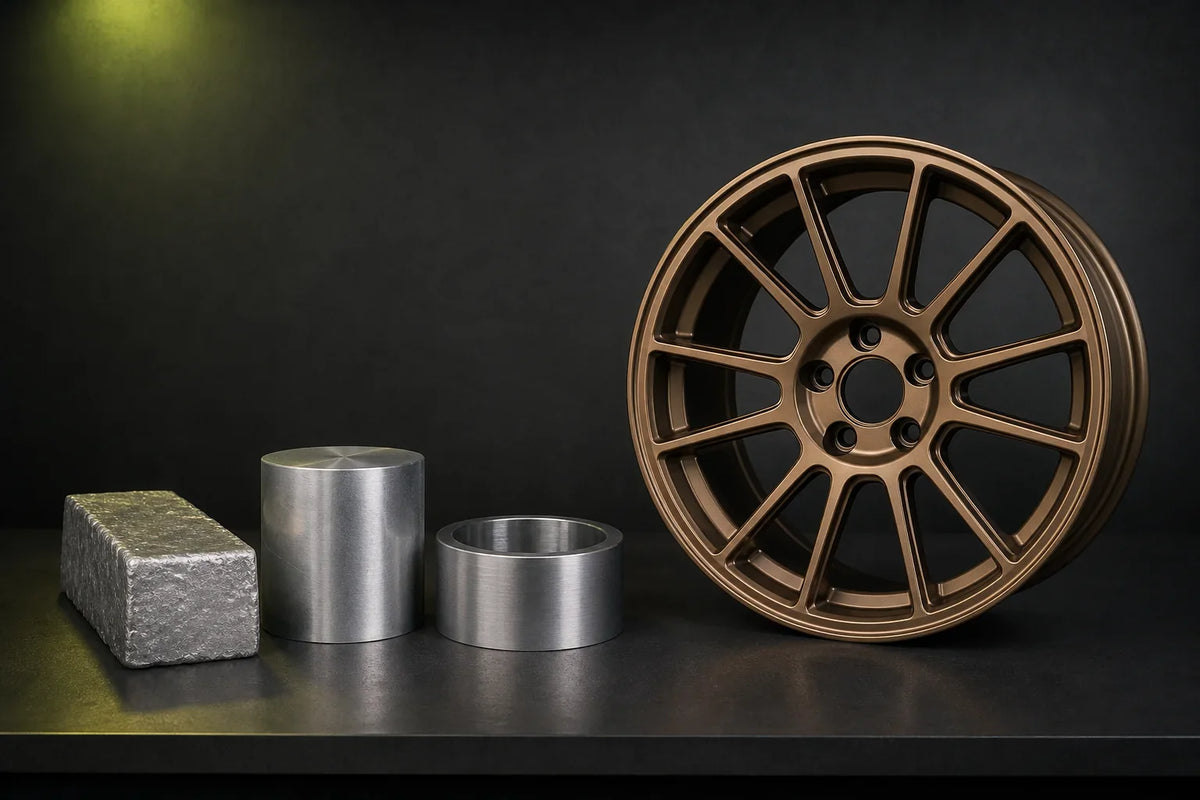

Cast, flow-formed and forged describe how an aluminum wheel takes shape. They do not, by themselves, tell you whether a particular wheel is light, strong, durable or right for your car. Those answers belong to the exact design, size, load rating, testing and fitment.
Start with the process, then inspect the product
Manufacturing labels are useful because process affects how designers can distribute material and how the wheel is produced at scale. The trouble begins when a process name is treated as a complete performance certificate.
“Forged” is not a substitute for a load rating. “Flow-formed” does not identify the weight of every size. “Cast” does not mean a wheel is unsuitable for serious road use. Compare the exact configuration: diameter, width, offset, load capacity, wheel mass where documented, finish, certification or test evidence, warranty and intended application.
| Method | General manufacturing route | Typical market position | What still needs verification |
|---|---|---|---|
| Cast | Molten aluminum alloy fills a wheel mold, followed by heat treatment, machining and finishing as specified. | Broad design choice and accessible production cost. | Exact load rating, mass, process control, testing, finish and fitment. |
| Flow-formed | A cast preform is rotated while rollers shape and elongate the barrel under controlled heat and pressure. | Often positioned between conventional cast and fully forged products. | Which part is flow formed, exact mass, load rating, testing and variant data. |
| Forged | Solid alloy stock is compressed into a dense preform, then machined into the final wheel architecture. | High material and machining cost with substantial design control. | Alloy, forging route, final design, load rating, testing, mass and fitment. |
How cast wheels are made
Casting creates a near-net-shape wheel by filling a mold with molten aluminum alloy. Production methods include gravity and low-pressure casting, among other specialized approaches. Once the casting is complete, the wheel may undergo heat treatment, machining, finishing and inspection according to the manufacturer’s process.
The commercial advantage is clear: casting can reproduce complex forms efficiently and offer a wide catalog of styles and sizes. The engineering result depends on much more than the word “cast.” Alloy selection, mold design, cooling control, porosity management, heat treatment, machining and quality inspection all influence the finished part.
For a buyer, the right question is not whether casting is “good” or “bad.” Ask whether the exact wheel has an appropriate load rating and verified fitment for the vehicle, and whether the supplier provides credible product documentation.
What flow forming changes
Flow forming adds a mechanical forming stage to a cast starting piece. The preform rotates while rollers apply pressure to the barrel area, changing its shape and thickness. The wheel face remains fundamentally associated with the cast preform; the process is concentrated on the rim or barrel section.
This distinction matters because marketing sometimes describes a flow-formed wheel as if the entire object were forged. It is more accurate to describe the confirmed process directly: a cast preform with a flow-formed barrel.
Flow forming can give the manufacturer additional control over barrel geometry and material distribution. It may support a lower wheel mass than a comparable conventional casting, but “comparable” is doing important work in that sentence. Different spoke designs, load targets, diameters and offsets can reverse a simple expectation. Compare published figures for the exact sizes rather than relying on category averages.
How forged wheels differ
Forged wheels begin with solid aluminum alloy stock rather than molten metal filling a final wheel mold. The material is compressed into a preform under high force, then the wheel is machined to create its spokes, mounting pad, center bore, lug seats and final surfaces.
The process uses more costly material, equipment and machining time. It also gives the manufacturer considerable freedom to remove material from low-stress areas and tailor a wheel for specific sizes, offsets and applications. That potential is valuable, but it is not automatic proof that every forged design is lighter than every flow-formed design or stronger than every cast design.
A conservative forged design for a heavy vehicle may intentionally carry more material than a lighter wheel intended for a smaller car. Application and engineering target remain part of the comparison.
Five claims to examine carefully
“Forged wheels are always the lightest”
Forging enables efficient material use, but finished mass depends on diameter, width, offset, load target and design. Compare like-for-like specifications.
“Flow-formed means forged”
Not in the usual automotive-wheel sense. Flow forming typically works the barrel of a cast preform. The terms should not be interchanged.
“Cast wheels are weak”
That statement is too broad to be useful. Properly designed and documented cast wheels serve many road applications. Suitability belongs to the exact wheel and vehicle.
“More spokes mean more strength”
Spoke count is a visual feature, not a standalone structural rating. Section shape, material, load paths, hub design and testing matter.
“A certification logo tells the whole story”
Marks and standards must be authentic, applicable to the product and supported by documentation. They do not replace checking the exact load rating and fitment.
Which manufacturing method should you choose?
The best answer depends on what you are optimizing.
- For a controlled budget and broad design choice: a properly specified cast wheel can be the rational answer.
- For a balance of price, barrel construction and potential mass reduction: compare flow-formed options using exact variant data.
- For high customization, application-specific machining or a premium material route: forged wheels may justify their cost.
In every category, the shortlist should still pass the same checks:
- Exact wheel size, offset and center-bore arrangement
- Verified load capacity for the vehicle
- Brake, suspension and body clearance
- Correct installation hardware
- Documented finish and care requirements
- Warranty and supplier support
How Dorimm should describe construction
Dorimm product pages should identify the confirmed construction method of each product and avoid expanding that fact into unsupported performance claims. If a wheel is flow formed, the page should also identify the exact available sizes, offsets, load information and relevant documentation. If a parameter is not confirmed, it should not be invented to complete a marketing table.
This approach is less dramatic than a blanket “motorsport technology” claim. It is also more useful when a customer is deciding what to install on a specific vehicle.
Manufacturing method FAQ
Are flow-formed wheels forged?
Flow-formed wheels generally start with a cast preform. Rollers then form the barrel under pressure. That is different from a fully forged wheel made from compressed solid stock and extensive machining.
Are forged wheels worth the additional cost?
They can be when their lower mass, custom specification, manufacturing route or application-specific design has value to the buyer. The benefit should be demonstrated by the exact wheel data, not assumed from the label.
Which method is best for daily driving?
There is no universal answer. A suitable daily-driving wheel needs the correct fitment, load capacity, tire, finish durability and support. All three manufacturing categories can contain products intended for road use.


